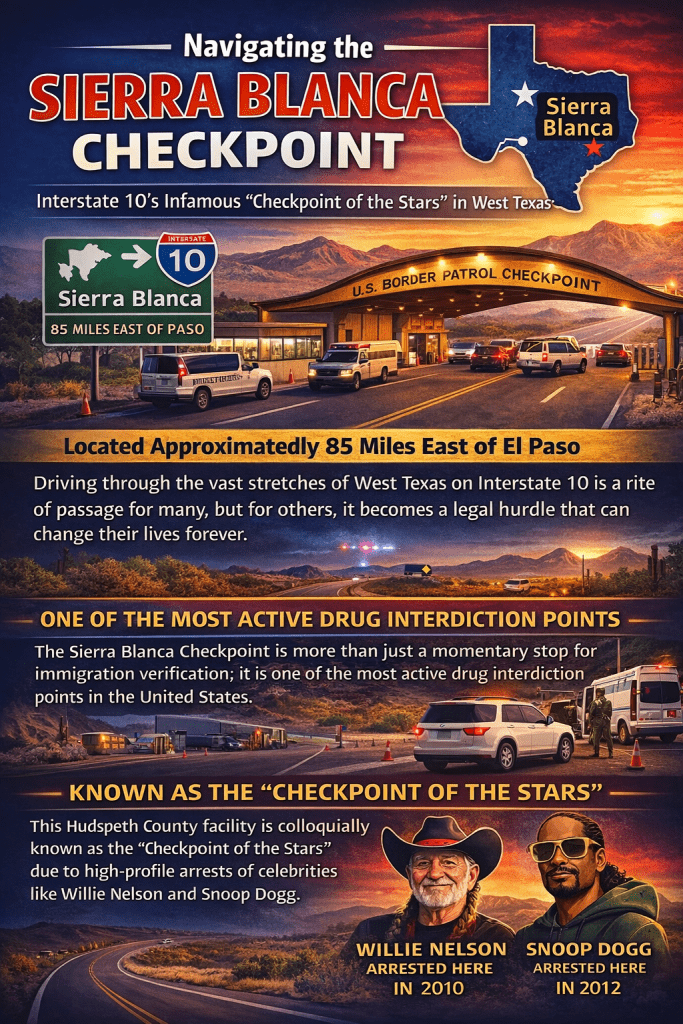
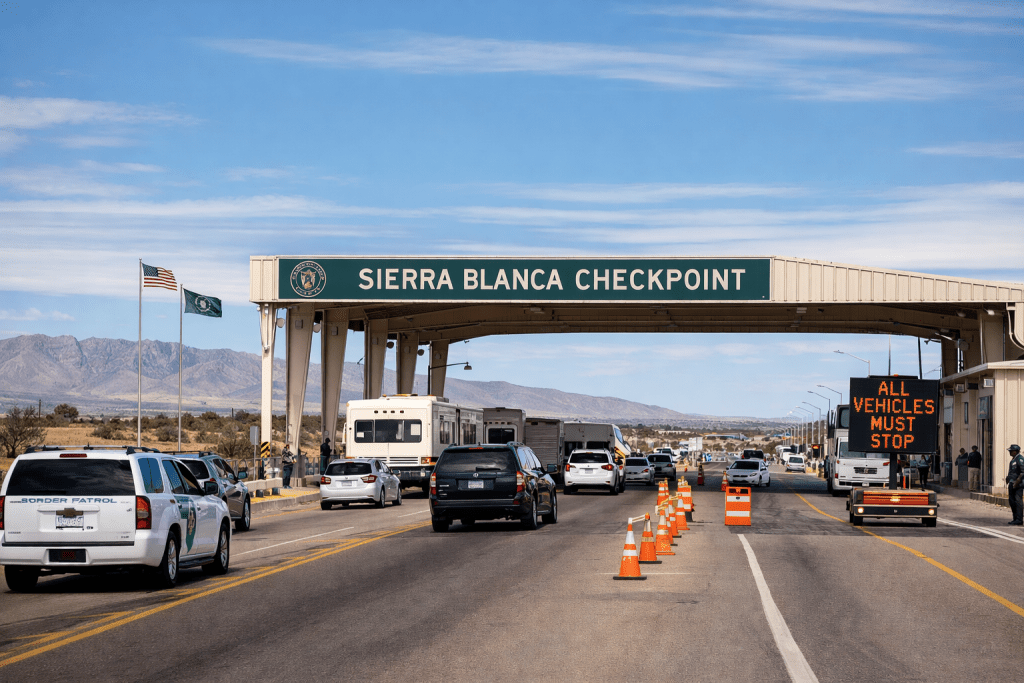
Driving through the vast stretches of West Texas on Interstate 10 is a rite of passage for many, but for others, it becomes a legal hurdle that can change their lives forever. Located approximately 85 miles east of El Paso, the Sierra Blanca Checkpoint is more than just a momentary stop for immigration verification; it is one of the most active drug interdiction points in the United States. Known colloquially as the “Checkpoint of the Stars” due to the high-profile arrests of celebrities like Willie Nelson and Snoop Dogg, this Hudspeth County facility is a focal point for federal and state law enforcement.
Find yourself pulled into secondary inspection or facing charges after a search? Understand the unique legal landscape of this mountain pass. Whether you are dealing with a small marijuana possession charge or a complex federal smuggling case, the Carl DeKoatz Law Firm provides the aggressive defense required to navigate the Hudspeth County and Western District of Texas court systems.
The Dual Nature of the Sierra Blanca Checkpoint
The primary, stated purpose of the Sierra Blanca facility is immigration inspection. Under federal law, the U.S. Border Patrol is granted the authority to operate fixed checkpoints within a “reasonable distance” (defined as 100 air miles) from any external boundary of the United States. Because Sierra Blanca sits within this zone, agents have the legal right to stop every vehicle to verify the citizenship status of its occupants.
However, as any local drug possession lawyer will tell you, the reality of the checkpoint is often different. Law enforcement agents are legally there to check for immigration status. However, they are accompanied by highly trained K-9 units. These dogs are not just sniffing for people; they are trained to detect narcotics. This dual-purpose enforcement often leads to a “legitimate” immigration stop transforming into a full-scale criminal investigation.
The Constitutional Foundation: Martinez-Fuerte
The legality of these stops was solidified by the Supreme Court in the landmark case United States v. Martinez-Fuerte (1976). The court ruled that brief, suspicionless stops at fixed checkpoints for immigration purposes do not violate the Fourth Amendment. However, the court also placed limits on this power. The stop must be brief, and a full search of the vehicle or its occupants requires probable cause or consent.
Your Fourth Amendment Rights at a Federal Checkpoint
Many drivers believe that because they are at a federal checkpoint, they have no rights. This is a dangerous misconception. While the rules are different than a standard I-10 traffic stop by a State Trooper, your constitutional protections still exist.
- The Right to Remain Silent: You are not legally required to answer questions about where you are going, where you are coming from, or what is in your trunk. While refusing to answer immigration questions can lead to a longer detention, you cannot be arrested simply for exercising your right to silence.
- The Right to Refuse Consent: If an agent asks, “Do you mind if we take a look in your trunk?”, you should know that you have the right to say “No.” Refusing a search does not provide the officer with probable cause to search you.
- Secondary Inspection: Agents have “wide discretion” to refer motorists to a secondary inspection area for further brief questioning. However, they cannot hold you there indefinitely without “reasonable suspicion” of a crime.
Legal Tip: If you are being held at the Sierra Blanca checkpoint for more than 10-15 minutes, you or your passengers should ask: “Am I free to leave?” or “Am I being detained?” If the answer is that you are being detained, the agents must be able to articulate a specific reason why.
Common Charges at Sierra Blanca: From Marijuana to Controlled Substances
The Big Bend Sector, which includes Sierra Blanca, consistently reports some of the highest drug seizure rates in the nation. Because I-10 is a major transcontinental artery, it is used by both casual travelers and organized smuggling operations.
1. Marijuana and THC Products
Even as laws change across the country, Texas remains a strict “zero-tolerance” state. If a K-9 alerts to your vehicle and agents find even a small amount of marijuana or a THC vape pen, you can be arrested. Often, these small-time busts are referred to Hudspeth County officials rather than being prosecuted federally. You may be offered a “paraphernalia ticket” or a Class B misdemeanor charge, but both carry long-term consequences for your record.
2. Controlled Substances (Felonies)
Possession of “harder” drugs like cocaine, heroin, or fentanyl is treated with extreme severity. In early 2026, the Department of Justice announced increased prosecution for any amount of fentanyl found at the checkpoint. These cases often land in the Western District of Texas federal court in El Paso, where mandatory minimum sentences can apply.
3. Human Smuggling / Alien Smuggling
With the installation of new semi-autonomous vehicle barriers (like the GRAB 350 system) in January 2026. The Border Patrol has intensified its efforts to catch “load drivers.” If you are found transporting undocumented individuals, you face federal felony charges for “Bringing in and Harboring Aliens” under 8 U.S.C. § 1324. These cases require a Sierra Blanca checkpoint attorney who understands federal sentencing guidelines and how to challenge the “intent” of the driver.
Navigating the Hudspeth County Court System
If you are arrested at the checkpoint and the federal government “declines” the case, it is handed over to the Hudspeth County Sheriff’s Office. Your case will then proceed through the local court in Sierra Blanca.
- The Sierra Blanca Courthouse: This is where local misdemeanor and state-level felony cases are heard. It is a small, busy court that handles a massive volume of checkpoint cases.
- The Prosecution Trap: Because the county relies on the revenue from these fines and seizures, they are often aggressive in seeking convictions. Many travelers simply “pay the fine” by mail, not realizing they are pleading guilty to a criminal offense that will follow them forever.
- Case Law Precedents: Cases like United States v. Portillo-Aguirre have highlighted the limits of how long Border Patrol can extend a stop to investigate drugs. We use these precedents to file Motions to Suppress, aiming to have the evidence against you thrown out if your rights were violated.
The “Fighter” Advantage: Why You Need Local Representation
When you are facing a judge in a remote area like Sierra Blanca or Van Horn, you need an attorney who isn’t just “visiting.” You need someone who knows the local prosecutors and judges by name.
Carl DeKoatz is a trial-ready defense attorney. We don’t just look for a quick plea deal; we look for the “trim”—the opportunity to reduce or dismiss your charges entirely. We investigate the reliability of the K-9 alert, the duration of the stop, and whether the agents had a valid legal basis for the search.
Whether you are a resident of El Paso, a soldier at Fort Bliss, or a commercial driver with a CDL, your future depends on the quality of your defense. Don’t let a mountain pass in West Texas be the place where your clean record ends.
Practical Advice for the West Texas Drive
- Check Your Cargo: Before leaving El Paso or Van Horn, ensure you have nothing in your vehicle that could trigger a K-9 alert—even “legal” CBD products can sometimes cause a false positive or lead to a prolonged search.
- Stay Calm: If you are referred to secondary, remain polite. Aggression only gives the agents “reasonable suspicion” that you are hiding something.
- Phone a Friend (or Lawyer): If you are arrested, do not make any statements to the agents. Simply say: “I am exercising my right to remain silent and I want to speak with my attorney.”
Contact a Sierra Blanca Checkpoint Attorney Today
If you have been arrested or cited at the Sierra Blanca Checkpoint, time is of the essence. We can often handle your case without you needing to travel back to Hudspeth County for every hearing.
- Office Location: 718 Myrtle Ave, El Paso, TX 79901
- Firm: Carl DeKoatz Law Firm
- Phone: (915) 577-0913